

Clinical Research Review: Comparing the Efficacy of Physical Therapy Interventions in Alzheimer's Disease: A Network Meta-Analysis
By: May Solis
Introduction
Alzheimer's disease (AD) is a progressive and irreversible neurodegenerative disorder that poses a significant challenge to global public health. Currently the fourth leading cause of death among older adults, AD affects millions of individuals worldwide. According to the World Health Organization, approximately 50 million people were living with Alzheimer's disease in 2018, with that number projected to increase to 131.5 million by 2050.
The disease affects multiple cognitive domains, including memory, executive function, language, and visuospatial abilities. As AD progresses, individuals also experience functional limitations that impact independence and quality of life.
Physical therapy interventions have shown promise in supporting both cognitive and physical function in individuals with Alzheimer's disease. Through processes such as neuroplasticity, improved cerebral perfusion, and stimulation of neurogenesis, these therapies may help slow functional decline and enhance overall well-being. Common approaches include music therapy, acupuncture, play therapy, cognitive training, and exercise therapy.
Purpose
The purpose of this review was to provide evidence-based guidance for clinicians when selecting among various physical therapy interventions for individuals with Alzheimer's disease. Specifically, the study compared the effectiveness of music therapy, acupuncture therapy, play therapy, cognitive training, and exercise therapy on cognitive and functional outcomes.
Methods
Researchers utilized Network Meta-Analysis (NMA), a sophisticated technique that allows multiple interventions to be compared simultaneously by integrating both direct and indirect evidence. This approach provides a comprehensive evaluation of treatment effectiveness and enables the ranking of interventions.
To determine relative effectiveness, the study used the Surface Under the Cumulative Ranking Curve (SUCRA) method, which ranks interventions based on their likelihood of producing the greatest benefit.
Definition:
Music Therapy: Incorporates music as a therapeutic tool to promote health and facilitate recovery.
Acupuncture Therapy: Utilizes traditional Chinese medicine techniques, specifically acupuncture, to balance the body’s vital energy (qi) and improve blood circulation.
Play Therapy: Engages play-based interventions to elicit adaptive responses within neuromuscular systems.
Cognitive Training Therapy: Psychotherapy focuses on altering negative cognitive patterns through cognitive and behavioral techniques.
Exercise Therapy: Employs physical exercise as a modality for disease management.
Standard Therapy (Control Groups): Includes pharmacological treatment, standard nursing interventions, daily activities or non-physical interventions.
Inclusion Criteria:
Studies were included if they met the following criteria:
Utilized a randomized controlled trial design.
Included participants diagnosed with Alzheimer's disease according to established diagnostic criteria.
Examined one or more of the following interventions:
Music therapy
Acupuncture therapy
Play therapy
Cognitive training therapy
Exercise therapy
Reported outcomes using one or more of the following measures:
Mini-Mental State Examination (MMSE)
Activities of Daily Living (ADL)
Alzheimer's Disease Assessment Scale – Cognitive Subscale (ADAS-cog)
Results
Cognitive Function:
The highest-ranked interventions for improving MMSE scores were:
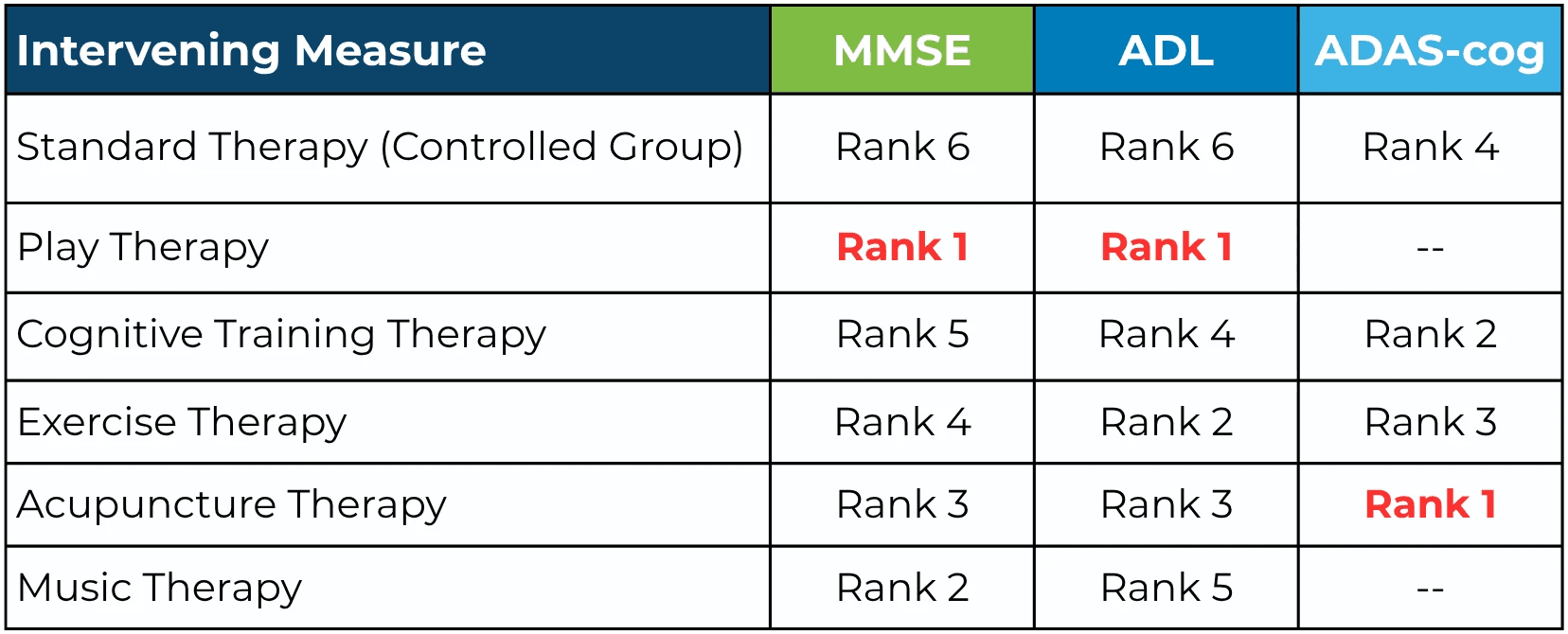
Play Therapy demonstrated the greatest improvement in cognitive function, likely due to its interactive nature and ability to stimulate neuroplasticity.
Music Therapy
Acupuncture Therapy
Activities of Daily Living (ADL):
The most effective interventions for improving functional independence were:
Play Therapy ranked highest, potentially because it combines both cognitive and physical engagement, supporting motor function and cognitive interaction simultaneously.
Exercise Therapy improved strength, balance, and mobility, all of which are critical for maintaining independence.
Acupuncture Therapy
Cognitive Function (ADAS-cog Outcome):
The highest-ranked interventions for improving ADAS-cog scores were:
Acupuncture Therapy – May provide neuroprotective benefits through modulation of neurotransmitters and reduction of amyloid-beta accumulation, suggesting potential value during earlier stages of cognitive decline.
Cognitive Training Therapy
Exercise Therapy
Table Ranking of Network Meta-Analysis Results:
Conclusion
This network meta-analysis highlights the varying therapeutic effects of non-pharmacological interventions for individuals with Alzheimer's disease. Play therapy and acupuncture therapy emerged as the most effective approaches for improving cognitive function, mental status, and activities of daily living.
Play therapy demonstrated the strongest short-term benefits, particularly in supporting cognitive performance and functional independence. Acupuncture therapy showed the greatest potential for long-term cognitive improvement, suggesting it may play an important role in slowing cognitive decline.
These findings reinforce the value of individualized treatment approaches that address both the cognitive and physical challenges associated with Alzheimer's disease. By incorporating evidence-based, person-centered interventions into clinical practice, rehabilitation professionals can help optimize outcomes, maintain functional abilities, and enhance quality of life for individuals living with Alzheimer's disease.
Reference
Wu, X., Lu, W., Li, Y., & Hu, X. (2025). Comparing the efficacy of physical therapy interventions in Alzheimer's disease: A network meta-analysis. Frontiers in Aging Neuroscience, 17, Article 1564205. https://doi.org/10.3389/fnagi.2025.1564205
<
>